Lemkus Gallery
04.12 - 31.01.2026
Work on paper, generally speaking, resists formality. Its disposability and difficulty to archive means paper is most frequently relegated to the realm of the draft; the space of ideas and thought prior to the artwork itself. The note – the preliminary mark – carries similar connotations. To bring together these thematic constraints, both so heavy with implications of informality, unfinishedness, and transience, presents a challenge both to the curators and the participating artists. The various ephemera that collect around the making of an art object tend to complicate it in a number of ways, blurring its edges not only in material and conceptual terms, but also in terms of space, time and authorship. ‘Notes on Paper’, curated by Jared Leite and Sihle Sogaula, shows evidence of these tensions, and reflects how different artists make choices regarding the exposure (or concealment) of the more unresolved, wobbly aspects of their practices.

Mitchell Gilbert Messina, First Sketch for “Artist Pacing around in Studio, Checking Emails”, 2025
To the immediate left of the entrance to the gallery, Mitchell Gilbert Messina’s First Sketch for “Artist Pacing around in Studio, Checking Emails” depicts the background process of an artist’s practice in simple moving-image. The work is a sort of motorised comic strip made up of five cardboard panels in a cardboard box frame, tacked together with tape. The panels rotate, creating an animated portrait of Messina, hands clasped behind his back, moving back and forth between one end of a room, where a laptop sits open on a desk, and the other. Messina characterises studio practice not as lofty and inspired, but as anxious, procrastinatory, and fundamentally mundane. The work itself is a ‘first sketch’, a pitstop on the way to something more resolved. Messina’s box sits alongside a series of pencil and charcoal sketches by Mmangaliso Nzuza which are similarly pared back and gestural, alluding to the visual language of cartoons – a departure from Nzuza’s more bold work in paint on canvas.
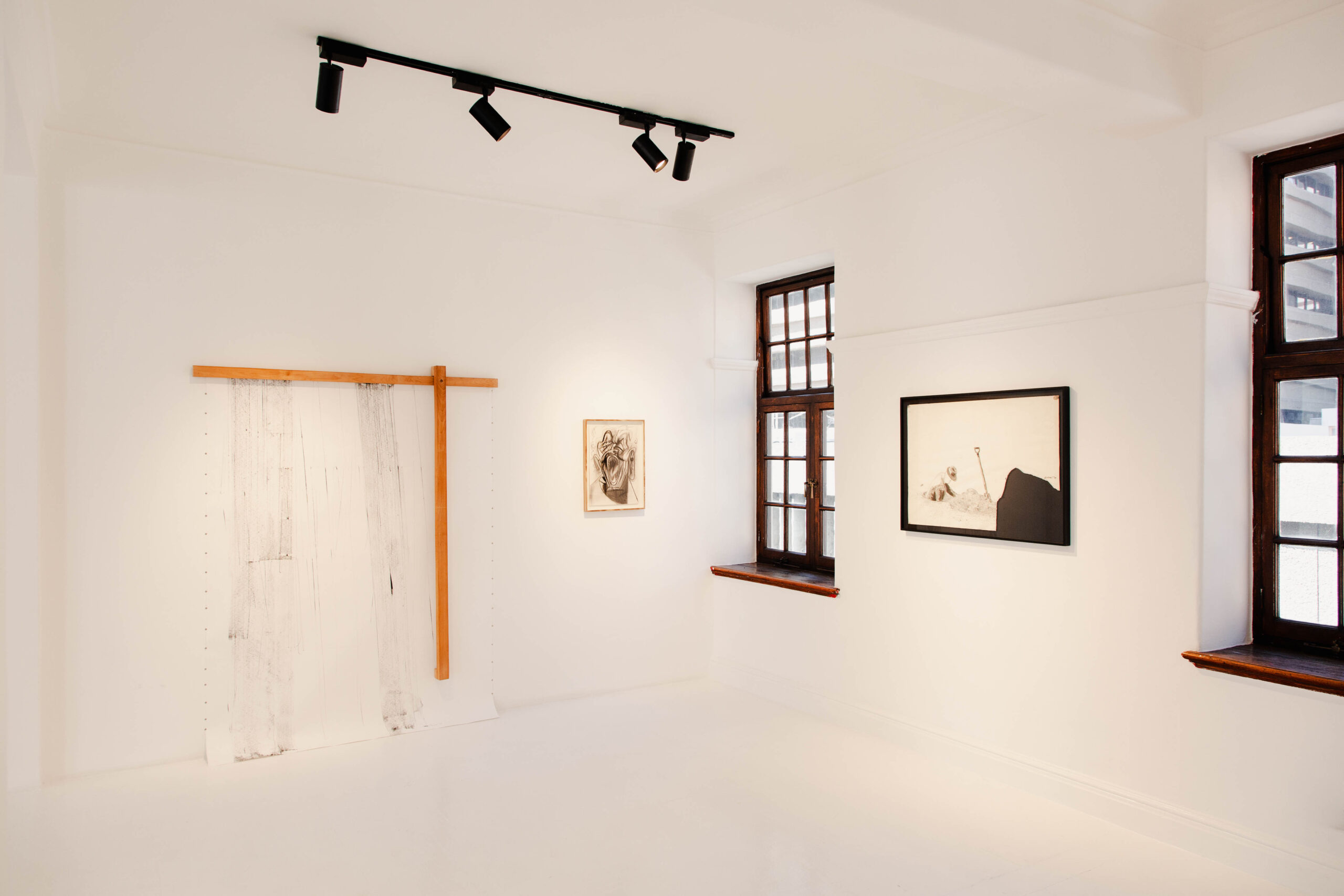
Process – time, labour, attention – is the shadow of the artwork, the impalpable material without which the art object is impossible. Process cannot really be visualised as such, only documented through traces, frozen in its various, singular moments. Kemang Wa Lehulere’s Gugusaurus, from 2010, is an ink on paper drawing of a figure digging a hole, an early iteration of the excavation motif that permeates much of Wa Lehulere’s performance work of the period. The bottom right-hand corner of the drawing has been torn off (apparently having been used to write a note), leaving a jagged-edged void behind. This absence resembles a dark pile of dirt – a hole remade from a hole – mirroring not just the act of digging – the displacement of material through action – but the iterative nature of the artist’s practice at large. This drawing, not made with the intention of exhibition but as an exercise in teasing out an idea and an image, is kept alive and in-progress by its missing corner. On the wall perpendicular is Unathi Mkonto’s Cultivating Soil, a large scroll-like piece of paper exhibited as it had been installed in the studio: thumb-tacked to the drywall and framed by the makeshift wooden ruler which was used to produce the strokes of ink that sweep vertically across the surface of the paper like washes of rain or the tracks of a plough. Here too, the process of making enters the same frame as the artwork, revealing its methodology, collapsing means into ends.
Installation View: ‘Notes on Paper’ at Lemkus gallery, 2025
For others, the methodology is the conceptual lynchpin of the work itself. Vusumzi Nkomo and Ndumi Mbala’s collaborative exercise in dictation, INDEXING IN WINDSWEEP, is a series of lists, written plainly on sheets of A4 paper: words and terminology relevant to the duo’s thought and practice (Hegel, Hegelianism, Hegelian, Hegemony). In conversation with this series is Kamyar Bineshtarigh’s Untitled (Nastaligh lesson with my father), a large sheet of paper with graphite lines ruled across it, upon which the artist has practiced the curves, flicks and swishes of Nastaligh – traditional Persian calligraphy – an art form in which Bineshtarigh’s father, Mohsen, is a master. Both of these collaborative exchanges reveal the ways in which the unseen, preparatory processes of artmaking are rarely solitary, with ideas often forming conversationally and within the frameworks of intimacy and trust. Moreover, they are fragments of language rather than narratives of their own, foregrounding the word – logos – its phonetics and diacritics, its many potentials for adjoinment in meaning, but not its signification. Logos of another kind festoon three drawings by Callan Grecia, part of a series titled Early 21st Century Bootleg (OG FAKE study). These drawings are pastiches of the ‘masters’ of modernity – notably Picasso – tacked onto backboards of paint-spattered cardboard and crowded by stickers bearing imagined brands. Together, these visual elements bring to mind the palimpsest of graffiti, posters and stickers on the walls and electricity boxes of busy city streets. The fake brands reference the title series, the notion of karma, and feature a nod to Baudrillard’s Simulacra and Simulation. This bricolage drags the canon into the present, grounding it within the visual language of public space and consumer culture.

Callan Grecia, Sonny Study, 2025
Grecia’s Sonny Study is pared back and muted in comparison. In this expressionist charcoal portrait of the late South African jazz musician Shunna ‘Sonny’ Pillay, his face is rendered in an angular distortion of anguish or ecstasy, teeth exposed in an open-mouthed howl. This reference to music is a current running through many works on the show, with improv jazz in particular feeling like an apt sonic analogue to many of the visual works included. Music, of course, also has notes. Like the word and its parts, it too is a fragment, given meaning through its grouping in a composition. Experimental mark-making exists in between the registers of language, music, and drawing, having capacity to be transferred between and among all three. A series of new abstract oil on canvas works by Wa Lehulere, Summer Notes in Winter I–IV, could be interpreted as unconventional musical scores (their characterisation as a ‘suite’ certainly supports this), while Mongezi Ncaphayi’s Infinite Possibilities I & II, abstract compositions in ink wash, pen, bright strokes of paint and aureoles of airbrushed colour, visualize the emotive landscapes of improvised jazz.
Mandisa Buthelezi, AmaNazaretha 10, 2024
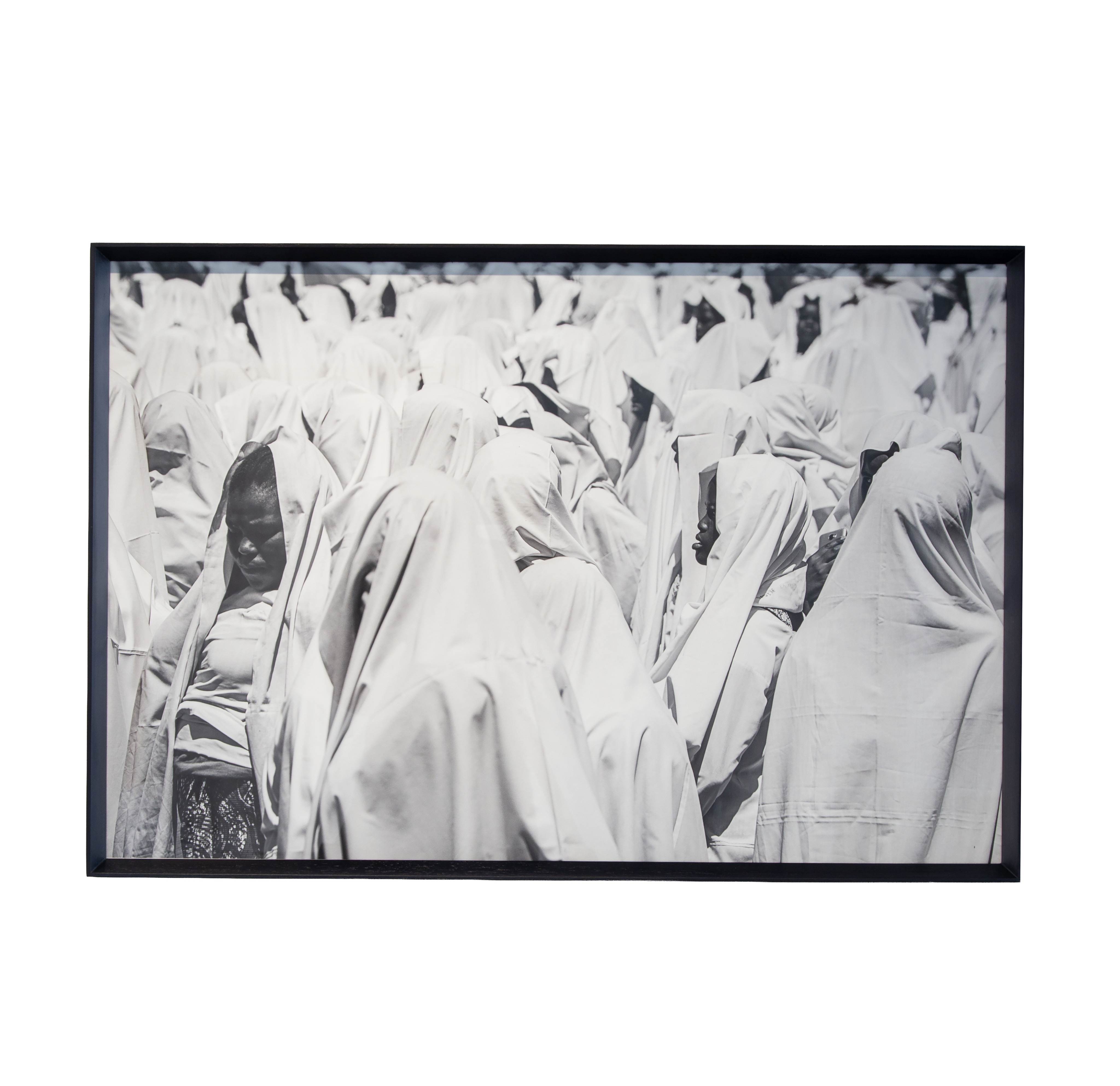
In photography, it is the momentary touch of light on film that creates the note. Two images captured by Mandisa Buthelezi depict crowds of Nazarene worshippers clothed in crisp white cotton. The starched headscarves worn by the women in Amanazaretha 10 resemble folded pages, drawing an oblique link between the art of the photographic print and the production of religious texts. thato makatu approaches the medium somewhat differently, emphasising the transience of the moment through their visual reference to the photographic test strip and use of non-archival developing materials (turmeric) in Growing Pains II. These photographic collages consist of near-abstract close-ups of interiors – a stainless steel sink; the light filtering through a kitchen window curtain – in golden and ochre hues, taped together with brown framing tape, conveying a sense of nostalgia and intimacy. Exhibited in the same room of the gallery as makatu’s photographs are paper works by Yonela Makoba, which echo this earthy tone and texture. Makoba’s work makes use of paper as its own surface, emphasising the situatedness of its materiality (after all, paper was once trees, growing in earth) by mixing in red ochre, ground stone, and tea to pigment the pulp. Parallel lines of stitching on the paper’s surface in Umnombo (the line) resemble an aerial view of the ruins of a building or an enclosure, and little impepho buds sprouting from The Land of Love and Grace similarly appear as trees as seen from the sky.
While Makoba’s work ties the materiality of paper to earth, land, and the work of metabolising raw material through artistic labour, Vusumzi Nkomo’s Double Duty: San Jose iron ballast V uses a map as its surface, in which the aerial view is surveyed, marked out in grids, and captured. The titular iron ballast, which is painted in silhouette using black shoe polish (another non-archival material that will change over time), was discovered in the wreck of the San Jose-Paquete Africa, a Portuguese slave ship carrying roughly 500 people captured from Mozambique, which sank off the coast of Cape Town in 1794. Over 200 enslaved people drowned. The ballasts, salvaged from the wreck in the ‘80s, had been used to stabilise the ship, counterbalancing the shifting weight of her human cargo at sea. What this work gestures towards is the ways in which bureaucracy (maps, ledgers, the calculated counterweighting of bodies) obfuscates the everyday terror of the slave trade in Southern Africa; how the deaths and displacements that resulted from it are borne in the objects that remain. Nkomo’s drawing is exhibited in a room to the right of the entrance, alongside two works by Maia Lehr-Sacks, and two by Pebofatso Mokoena. Mokoena’s monotype Expeditions on Pluto also includes a shape resembling a diagram of a slave ship, with its arrangement of bodies in rows. Among other hand-written phrases, with references ranging from sci-fi to hip hop, are the words ‘war is a synthesis machine’.
‘Installation View: ‘Notes on Paper’ at Lemkus gallery, 2025
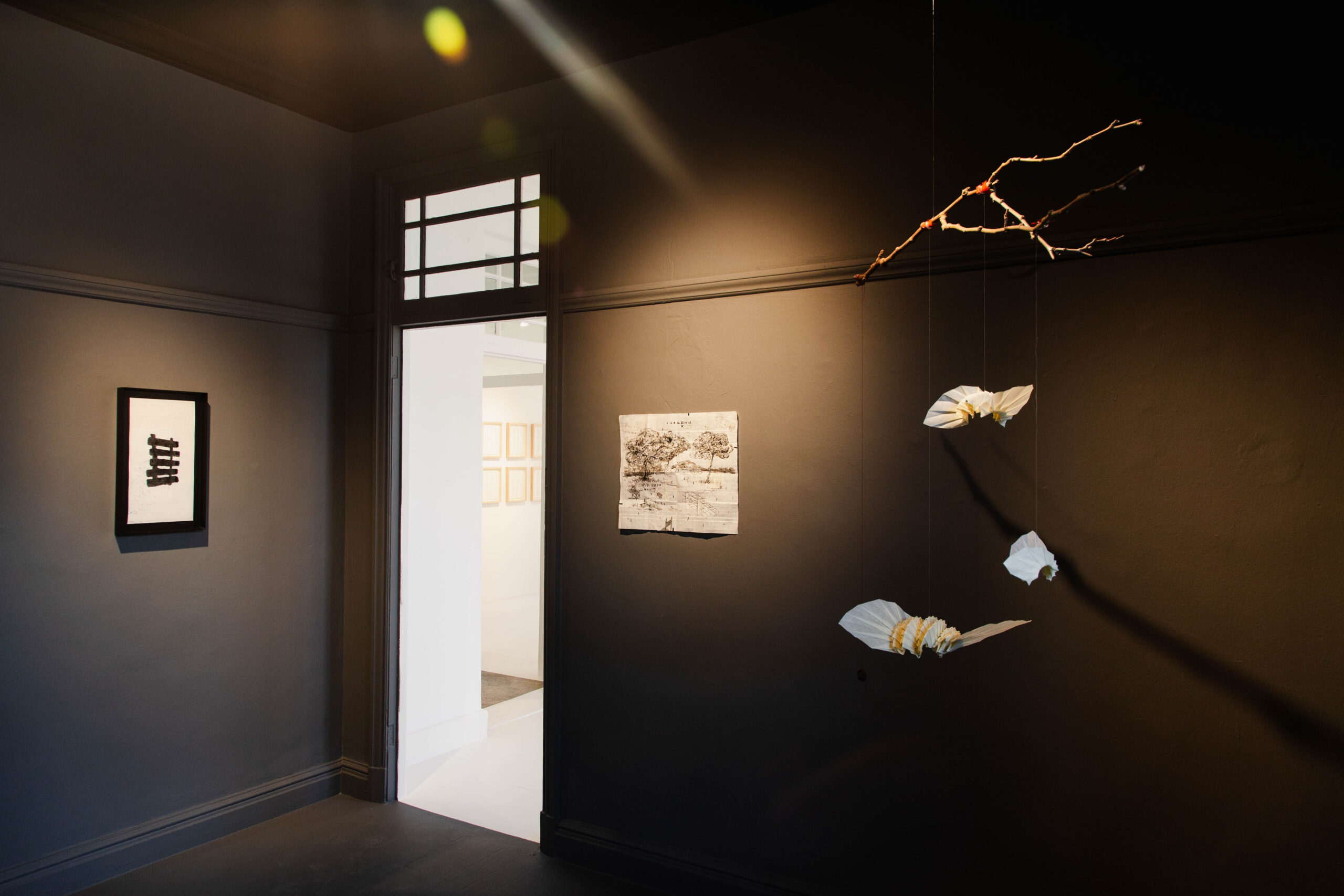
The room is painted a dark grey, emphasising the restless shadows cast by Lehr-Sacks’s mobile of folded paper nautiluses, counterweighted by a black hagstone. These small sculptures, though delicate, have an architectural quality to them, which is echoed in Lehr-Sacks’s accompanying sketchy drawing, a landscape of sorts, but one that is preoccupied with the fold: numbers multiply at the top of the page; grid-like sculptural forms occupy the same space as garden furniture. What emerges in the curation of Nkomo, Mokoena and Lehr-Sacks together, is a fascination with the grid; the fold, and its relationship to space, both real and represented; both enclosed and unravelling. This interest in folding – which is also a means by which to create space – emerges too in another room, with Daniel Bradfield’s cardboard forms – attempts at untangling Hegelian philosophy through non-linguistic means. These boxes, though presented as works on their own, come with a set of instructions to visitors on how to produce their own versions of them, perhaps also prompting philosophical meditation.

Installation View: ‘Notes on Paper’ at Lemkus gallery, 2025
Despite being tucked away at the back of the gallery space, in a passageway leading to the bar and bathrooms, Pebofatso Mokoena’s numerous notebooks – arranged on a set of shelves – feel like the anchor of the exhibition. Some of them contain notes to self and studies of academic texts, while others are filled with pages of abstract, gestural marks in ink. In Mokoena’s standalone works, these apparently disparate forms of work take shape together. The mark and the note in dialogue – the unity of known and unknown language coalescing to produce its own forms of meaning – but always refusing to remain static or to be made fully transparent.
Mokoena’s notebooks are evidence of the mundanity of planning, ideas work, the protracted intellectual labour of preparing to make ‘the art object’, and the fact that practice requires practise. Paging through these notebooks, I was struck by the lines ‘writing in traces / writing systems as praxis / understanding is the proof of error’. The last phrase appears in Clarice Lispector’s short story The Egg and the Chicken1Originally written in Portuguese., a labyrinthine meditation on identity, gender, creation and lack. The egg is the thing the chicken holds within it, unaware that it will be; what it will be. “The chicken is the egg’s disguise”. Mokoena’s notebooks most aptly summarise the ethos of ‘Notes on Paper’, but they also reveal the space before the artwork, before the note, before language and sound. They show those moments of collaboration with the world in the gestation of ideas, reminding one that rumination on what exists already is ultimately the prompt for what does not yet.